The Appeal of Generic Software
When an auto glass shop owner first starts looking for software, the options are overwhelming. There are hundreds of CRMs, scheduling tools, and invoicing platforms — many with slick interfaces and impressive feature lists. It’s tempting to pick something familiar, like HubSpot or Salesforce, and adapt it to your workflow. But adapting generic software to an auto glass operation is like using a flathead screwdriver on a Phillips head screw. It sort of works — until it strips the screw entirely.
What Generic Software Gets Wrong for Auto Glass
Generic CRMs are built for the average business. Auto glass isn’t average. Consider what your operation actually needs that no general-purpose tool provides natively:
- NAGS pricing integration: Your quotes are built against a specific pricing database. Generic tools have no concept of NAGS, part numbers, or labor time standards.
- VIN-based quoting: Every job starts with a vehicle. You need to look up the right glass by VIN, year, make, model, and trim. A generic CRM stores contacts — not vehicle records.
- Insurance billing workflows: TPA networks and direct billing require specific workflows that no general business tool supports.
- Technician dispatch for mobile jobs: Route optimization, zone-based dispatch, and mobile job updates require a tool that understands field service.
- Glass-specific inventory: Tracking windshields by part number with VIN compatibility is not the same as tracking retail products.
The Hidden Cost of Workarounds
Shops that run on generic software always end up with workarounds: a spreadsheet for pricing, a whiteboard for scheduling, a separate tool for invoicing. Each workaround introduces a new handoff point — and handoffs are where errors happen and time disappears. The real cost of a generic setup isn’t the monthly subscription. It’s the accumulated time your team spends maintaining workarounds and dealing with the errors they produce.
What Industry-Specific Software Changes
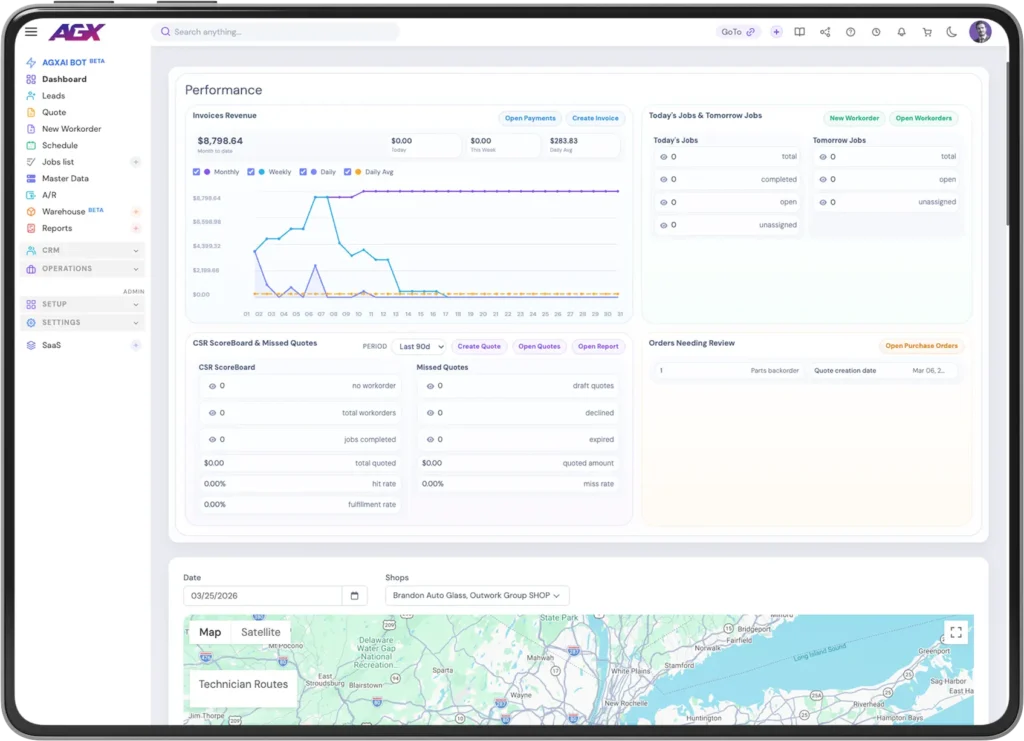
AGX was built from the ground up for auto glass. Every workflow — from Fast Quote through work order creation, technician dispatch, customer communication, insurance billing, and analytics — was designed around how auto glass shops actually operate. A VIN entered at quoting flows through to the work order, parts order, technician instructions, and final invoice without a single manual re-entry. That kind of end-to-end flow is only possible in software built for this specific industry.
The Right Tool for the Right Industry
You would not use general-purpose accounting software to manage your glass inventory, and you would not use a generic scheduler to route your technicians. The same logic applies to your shop management platform. Industry-specific software pays for itself quickly through the time saved, errors eliminated, and capacity unlocked.
FAQ
You can, but you will spend significant time and money customizing them for NAGS pricing, VIN lookups, and insurance billing — features not in their core product. Most shops that try end up with a patchwork of plugins and workarounds that is more expensive and less effective than purpose-built software.
The non-negotiable features are: live NAGS pricing integration, VIN-based vehicle lookup, insurance billing workflows, zone-based technician dispatch, and glass-specific inventory management. None of these exist natively in any general-purpose CRM.
Not when you factor in total cost of ownership. Generic tools require expensive customization, plugin subscriptions, and ongoing workarounds. AGX includes all auto-glass-specific features natively with no add-on costs for NAGS integration, scheduling, or customer communication.
Most shops complete the transition in 2-3 weeks with full operations maintained throughout. AGX guided onboarding includes data migration support to ensure your customer and job history transfers cleanly.
The Appeal of Generic Software
The AGX team combines auto glass industry expertise with modern software engineering to build tools that help shops run smarter, grow faster, and serve customers better. AGX is the only shop management platform built exclusively for the auto glass industry.
Learn more at www.agxai.com.